Friday, 1 June 2012

Bari and the ferry to Greece

Took the highway route this morning to the port town of Bari. The ferry port was well signposted and we easily found the ticket office for Superfast Ferries. All cabins for the 10 hour overnight voyage to Igoumenitsa in Greece are booked so we have had to settle for aircraft type seats in the lounge.

Locked our jackets and boots in the Pacsafe and went for a walk into town as we have 5 hours to kill before boarding. For anyone who doesn’t know what a Pacsafe is they look like this.


They are made of stainless steel mesh. The weakest point is probably the padlock which could be broken open with bolt cutters but it’s enough to deter opportunist thieves. I have put the cable through the front wheel to secure it.
The part of town near the port is not what we expected. Nice cafes, clean and very pleasant alleyways with a maze of 4 story apartment blocks that look as if they have been standing for centuries but are in very good condition, several churches tucked away, piazzas and a 11th century castle build by Roger the Norman. Again the castle has been renovated/modernised and turned into a museum. The extensive modernisation works were probably inevitable in this case because in previous centuries it was used as a prison and a barracks, so the alterations no doubt went beyond the point of no return.


That's me having a post-lunch nap
Some last comments on our time in southern Italy: people are very friendly and keen to practice their English on us, good drivers who are very considerate to motorcyclists and unpredictable foreigners who appear to be lost, good food and house wines at very reasonable prices, not a great selection of dishes for vegetarians, hotels and B&Bs difficult to find in country towns and villages (unlike northern Italy where a few years ago they were everywhere), coffee/café  culture is very strong. Generally we preferred Corsica and northern Sardinia which have all the best aspects of Italy without the dirt, congestion and chaos of the city areas.
When we rode on board the boat we discovered that they don’t tie the bikes down. That is the responsibility of the rider. Searched around and found an abandoned tie down and a piece of rope and did the best job I could. Tomorrow morning we’ll see if it worked though I had great difficulty finding somewhere to tie down to. Then headed for the reception desk to enquire whether there was any possibility of getting a cabin in the event of a no show. Had to wait to see the purser who was dealing with a couple of unhappy passengers who had got to him before me.  When it came to my turn I walked in with a big smile, wished him good evening in Italian and asked in English whether there was any possibility of getting a cabin. He smiled back and said yes but they are very expensive. After a few jokes about oldies and only being able to afford to travel on a motorbike he managed to discount it about 50% to 124 euros. When I said I would have to get the approval of the Minister for Finance he thought that was hilarious and when I returned he said he would upgrade us at the same price to a deluxe external cabin with a window. It just goes to show what a smile and a crap attempt to speak the language can do. He even got a porter to take our stuff to our room.

Excellent meal for dinner. Pork tenderloin stuffed with blue cheese and herbs and stuffed peppers. Gail had the stuffed peppers with rice with a tomato based sauce. Tried Greek draught beer and a bottle of retsina which smells to me a bit too much like citrus floor cleaner but tastes fine. Tonight we have to plan our route for tomorrow which will be fun as we have only an Italian map of Greece and the names of the towns are in Italian.


Thursday, 31 May 2012

Matera

Rode a scenic major highway with almost no traffic on our way to our next destination, Matera. The road infrastructure in this part of the country is very impressive. I didn't mention yestesterday that we went through about 20 tunnels through mountain ranges up to 1 km long; and today we more of that elevated highway with fantastic views on either side. For the Bega Valley readers, imagine a 2 lane road that tackles Brown Mountain by leaping into space at Pipers Lookout and descends slowly in nice arcs to land on Little Brown Mountain and then goes through the air to the range north of Pollacks Flat Road and joins the existing road at Numbugga. That's how they would tackle Brown Mountain here! The cost must have been huge. Though maintenence must be a problem because some of the road surfaces need urgent attention.


photo taken from about 1000 m elevation


Near Potenza we left the highway and went up into the mountains on a minor road through deciduous forests and cork oak plantations and then down through wheat and hay country to the town of Matera.

The tourist information centre in Matera found us a B&B  on the edge of the old part of town. We have a huge room with a kitchen and dining table and the bike is parked just outside the door in the narrow street.

We thought that with it being a tourist town the restaurants would be a rip off but my lunch of salmon and spinach fettucine with a basket of bread and a 1/4 litre carafe of the local red wine , plus a plate of homemade peanut brittle, cost the equivalent of just $12.50 and tasted superb.

The old part of Matera is called Sassi meaning "stones" because the original houses were carved out of the limestone rock. The first cave houses date back to the 8th century. In the 18th and 19th centuries more conventional one and two storey buildings were constructed on the hill among and above the caves using limestone blocks.


We visited one of the old cave houses which had one room for the family and at the back of it a room for the mule and another for the pig and the chooks. The smell must have been terrible.


Note the high bed which was elevated above the floor as high as possible to get away from the filth. Their infant mortality rate was 50% so the government began a rehousing programme in the 1950's. This house was vacated in 1956. Now the area is a major tourist destination and Mel Gibson used it as the location for his movie about Christ.


Wednesday, 30 May 2012

Amalfi Coast and then inland


At breakfast I heard a French guest at the hotel telling the proprietor that it had taken him and his wife all day to drive the 45 km to Amalfi and back to the hotel the previous day, because of the density of the traffic and stops to take photos and eat and drink. Our plan for today was to head towards Sorrento, take the mountain road south across the peninsula and the ride the Amalfi  Coast and then head into the interior of Italy.
By setting out just before 8.00 am we manage to beat most of the tourist buses for the first hour or two and had a reasonably clear run. The Amalfi Coast Road what not what we expected. We thought it would be near sea level but it is half way up the immense cliffs and is several hundred metres above the ocean with magnificent views up and down the coast and down to the seaside towns. We were able to stop the bike several times to take photos, which would not have been possible if we had been travelling by car. In fact many of the best views would have been totally impossible to see from a car because the stone walls at the edge of the road would have obscured them.
Looking back where we have ridden.
You can see the road running horizontally nearly half way up.

Just after Amalfi we turned into the mountains and headed for the cliff top town of Ravello where we stopped for coffee. On the way up we passed a flock of goats wandering along the side of the road guarded by a scruffy looking maremma dog which attempted a token chase after the bike. According to the guide books Ravello is one of the most scenic towns in Italy. We wandered around the old town a bit and had a coffee in the piazza. It had taken us 3 hours to travel the 48 km to here, most of it in 2nd gear.

When we topped the mountain range and saw the vista on the other side we couldn’t believe our eyes. The area in front of us which ranged from the outskirts of Naples to the outskirts of Salerno is totally built up; just one huge mass of humanity, traffic and chaos. We descended into the middle of what seemed to us to be busier, dirtier and noisier than Delhi in India. How people can voluntarily live in a place like this amazes me. After getting lost and twice asking our way we eventually found the autostrada and got the hell out of there.

The other side of Salerno we stopped at a services area and bought sandwiches for lunch and continued east along the autostrada until we struck north at Contura into beautiful mountainous country that was very similar to parts of the Alps. Much of the first 25 km was on an elevated roadway that spanned across valley and gorges and must have cost a fortune to construct. The traffic was so light when we got on to the minor roads that the solitude was a bit un-nerving after the congestion of the past few days. Now we were up in what the road signs said is snow chain country in winter.

Found our way to the town of Melfi where after asking directions to a hotel we found a room in the hotel next to the railway station. Walked through the alleyways of the old part of town and visited the cathedral and the 11th century castle which has been ruined by recent renovations using EU money that has included the installation of modern windows and doors and white internal wall plaster and conversion to a regional museum. What a sad loss. But thinking about it, a plaque on the wall said it was Norman castle which means it was built by French invaders from Normandy, so perhaps that's why the Itaians didn't think it was worth preserving.

Tuesday, 29 May 2012

Naples and Pompeii

The boat discharged us late, about 12.30, in to the chaos of Naples traffic and on to their appalling road surfaces. We headed out of town on a major road of potholed cobbles with broken drain covers, no road signs and a self-inflicted maximum speed for all traffic other than some crazy scooter riders of 20 kph or your vehicle would be shaken to pieces. The road lined with shops, offices and workshops topped by storeys of apartments with washing billowing from their windows and balconies. Cars, vans and trucks double and even triple parked and emerging from all directions. This went on for about 40 minutes until we decided to head inland and get onto the toll autostrada and head straight for Pompeii, abandoning all thoughts of finding Herculaneum.

Being on a bike we were able to park right outside the entrance to the Pompeian ruins instead of having to pay for parking hundreds of metres away. We put our jackets and other gear in our Pacsafe stainless steel mesh basket and locked it to the bike. That way we could walk around in the heat without having to carry them.

Everyone knows the story of Pompeii and what has been found by the archaeologists, but we were amazed by the scale of it and how much of the town is still standing. The old city covers 66 hectares of which 50 have been excavated to reveal streets of buildings including the forum, temples, markets, shops, houses, baths, a laundry and municipal offices. None have roofs but most have walls still standing to full height many with frescoes, sculptures and mosaics. The Mount Vesuvius eruption of 79 A.D. which covered it all in ash and rock preserved it amazingly.


Vesuvius in the background

After spending 2 and a half hours there and seeing only a fraction of it we got back on the bike and returned to the heavy traffic with the aim of finding a hotel as soon as possible. An hour later we decided that anywhere would do so we stopped at the next hotel which happens to be high up on the Cliffside looking towards Sorrento. It’s one of those places where the proprietor personally introduces himself and shakes your hand when you arrive and the porter takes the luggage to your room. At a claimed heavily discounted price of 100 euros including breakfast it is still beyond our budget but just look at the view from our balcony.


Our plans come unstuck!

There isn’t a ferry to Sicily until 4 days’ time! So we had to do a rapid rethink and I’m writing this on board a ship to Naples. It is a 17 hour voyage and it is more of a roll on roll off freight ship than a ferry. There are only 15 cars, a campervan, 12 foot passengers, 6 motorcycles and one bicycle on board, but lots of truck trailers with containers, tankers or open freight. When we get to Naples tractors will pull the trailers off the boat so they can be connected up to prime movers and continue on their journey. The ship is fairly old and shakes, rattles and vibrates a lot. Our cabin is basic, a bit worn but clean. There is a lounge, bar and self-service cafeteria. Gail was a bit perturbed by the ferries we have taken so far so this is right outside her comfort zone, 17 hours on the open sea in a rattling comparative rust bucket.

When we bought the ticket we thought it was a normal ferry and assumed it would have a shop on board where we could buy a map of northern Italy as our map doesn’t go far enough north, but of course there is no shop on board this ship so we can’t even plan where to go when we land. What an adventure, I love it. Time for another red wine or two.
A reasonable night’s sleep. Breakfast of cappuccinos and apricot filled croissants. Sunny sky and flat sea.

We’ve decided to go south from Naples and try to find Herculaneum and Pompeii. The only map we have is very small scale so navigation may be a challenge. Then we’ll head for the Amalfi Coast.
approaching Naples


Southern Sardinia

When we were checking out of the hotel in the morning the guy at reception asked where were going today. When we showed him on the map that we intended to visit the Nuraghi archaeological site near Barumini he insisted that the best way to get there was to take the highway south and then double back to Nuraghi Su Nuraxi. We shouldn’t have listened, the highway was fast but boring and we got tied up in road works.

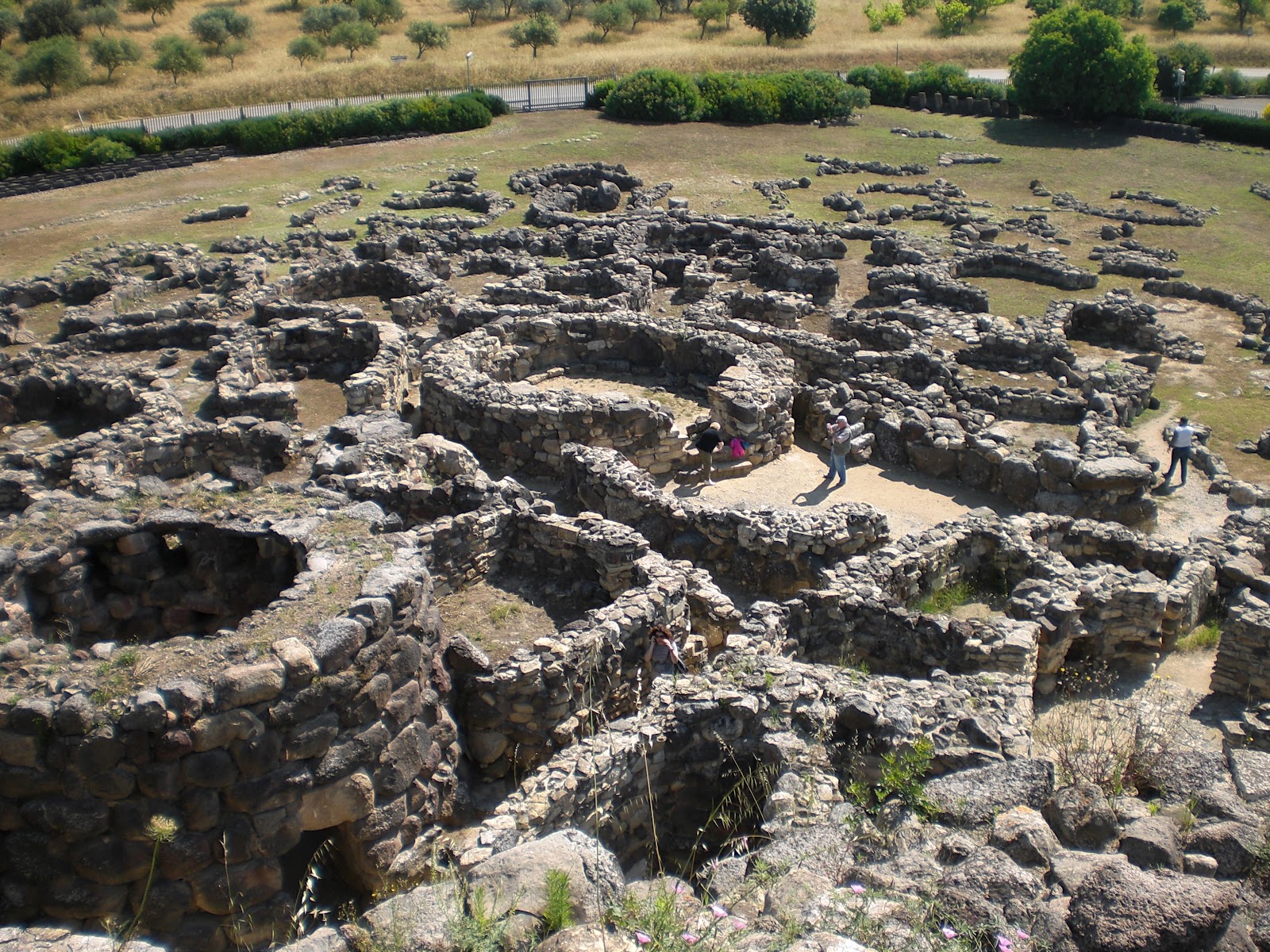
The archaeological site itself was very interesting. The Nuraghi were the people who inhabited Sardinia 3,000 years ago. They had relatively advanced building construction techniques for what was then the Bronze Age and there are remains of about 7,000 examples of their buildings on the island.
At this site there is a central 3 storey tower, though the top storey is missing, with four 2 storey towers at the cardinal points around it and a connecting wall between them, so when built it looked similar to a medieval castle of over 2,000 years later. They know it had ramparts around the top of the outer wall and the central tower because during excavations in the 1950s they found a scale model in clay that showed the original shape of the tower and explained the purpose of the shaped cantilever rocks that they had found, which served as supports for the ramparts. Outside the fortress are the remains of a closely built village of houses with up to seven rooms. Every room and tower is circular in shape and reduces in diameter as it gets taller. The towers were built of volcanic basalt for their full height, so they are a tall beehive shape, but the rooms of the houses had dwarf rock walls topped by a wood and thatch dome roof with a central open space. Life must have been pretty desperate 3,000 years ago if the people had to go to such great lengths to construct a complex stone fort to protect themselves and their food stores from their neighbouring tribes.

It cost 9 euros each for a tour which was conducted in Italian and English. Well worth the money.


After a coffee in a nearby café we took the country lanes to Cagliari though very pleasant undulating scenery with many olive groves and masses of beautiful wild flowers on the road verges and in the many of the fields; mainly red poppies, tall yellow daisies and a purple flower of some sort. Looking for a lunch stop we passed through many villages but they had shut down for their noon to 4.00 pm lunch break. Eventually found a supermarket that was open and bought some pre-packed sandwiches which we ate in the shade of the awning of a closed café in a small park.
Continued on our way to Cagliari where the plan was to buy a ticket for an overnight ferry to Sicily.

Sunday, 27 May 2012

West coast of Sardinia

Started riding at 8.00 am after a breakfast of bananas, cheese and bread that we bought the previous evening. Amost the only vehicle on the road we cruised SW along the Costa Paradiso (Paradise Coast)which lived up to its name, with rugged rocks and deserted white beaches on our right and countryside that reminded us of Connemara in Ireland – small fields scatted with boulders and with drystone walls and full of wildflowers. Lots of camping villages and eco-resorts but all of them closed as it is out of season. Passed the lovely hill-top old fortified town of Castelsardo which looked very interesting but we decided to keep going as it was too early for a coffee stop. Skirted the city of Sassari and went south to Alghero, a place that is described on some websites as one of the best coastal sights in Sardinia, a claim that we though a bit exaggerated but it is certainly nice. It has all the touristy trappings like seafront cafes and horse and buggy rides, but I have to say I preferred the place where we stayed last night because it was more genuine.

Had cappuccinos and then got on one of the boats going to Cape Caccia to see Grotta di Neptuna (Neptune’s Cave). A good way to spend 3 hours but the sales pitch is a bit misleading. We got the impression from their advertising board on the wharf that the boat actually went into the cave to see the stalactites and other formations, but in reality they put you on shore and then you have to buy a 13 euro ticket on top of your 15 euro boat fare to enter the cave. Once inside it is very nice, with 2 main chambers full of very nice limestone formations and several water pools.


The boat trip out and back is spectacular in itself, cruising past high limestone cliffs on flat calm water.


Back on shore we continued south long a very scenic winding road with more rocky coast on our right and this time mountains on our left. The mountains are “softer” than those in Corsica, being covered in vegetation rather than bare and craggy.

A late lunch at an outdoor café at Bosa Marina and then as we continued south we started looking for somewhere to stay the night. We soon discovered that on Sunday afternoon Sardinia is closed! We found hotels but their doors were locked and many had their shutters shut tight. We went through some small towns that were almost devoid of any sign of life. Eventually we found a Travelodge type business hotel in the not quite so deserted large town of Oristano, but I’m sure we are the only people staying here. Nice room at a good price including breakfast.
Wandered into town at  7.30 when the place was just starting to come to life again and the restaurants were open for drinks but not for food yet and found beer, wine and a great dinner in an alleyway restaurant though it cost us an arm and a leg because we splurged a bit. They seem to be very nice people in Sardina and are very helpful to those of us who dont speak a word of their language.